

.jpg&name=Pollen Granules (Wild Spanish)&caption=Natural Supplements from Regenerative Nutrition&redirect_uri=https%3A%2F%2Fwww%2Eregenerativenutrition%2Ecom%2Fpollen%2Dgranules%2Dp%2D73%2Easp%3Fxcur%3D3)

Pollen Granules (Wild Spanish)
- Information
- Ingredients / Directions
- Further Reading
- Health Uses
|
|
|
|
Ingredients
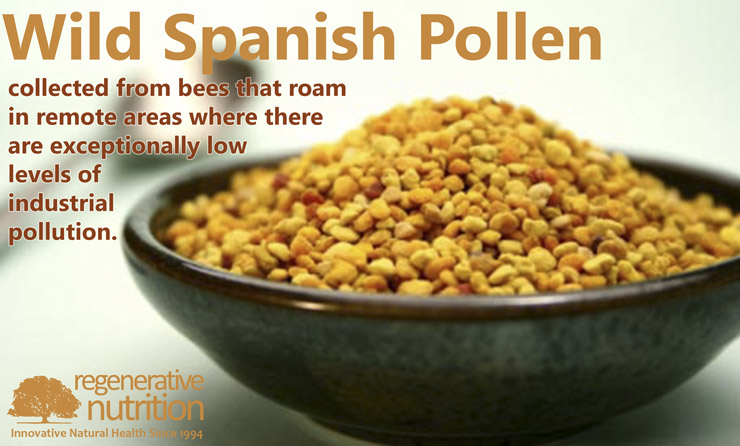
Wild Pollen *** NOW IN 200g POUCHES ***
Collected by bees in the remote low pollution areas of north-west Spain where the area is rich in polliniferous plants, with no intense farming. The Bees only forage on wild flowers, collecting pollen from different kinds of wild citrus and other wild plants; including Heathers, Labiates, Strawberry trees, Oak and Holm Oaks.
Some sensitive individuals will benefit more from as little as one quarter of a teaspoon daily.
For airborne pollen allergy sufferers: best taken for a few months before the pollen season, to build immunity.
Taking Ionic Liquid Minerals in conjunction with pollen can be even more beneficial for sensitive types.
For best results for the first month of use take pollen daily for three days then take one day off
For curing chronic disease, for improving immediate health concerns and for preventing future illness and improving vitality, wellness and longevity; the amount you take for best results should normally be gradually increased from about 1 teaspoon; one to three times a day (depending on your sensitivity*) to one dessert spoon, before meals, three times a day. As it is a completely balanced, complete food concentrate then there is no toxicity. It can in fact replace the whole diet, so some individuals take even larger amounts than 3 dessert spoons a day. For example, some people take larger amounts for competitive sports training. Some use larger amounts to combat the effects of extreme toxicity (such as during chemotherapy). In some cases larger amounts are used in establishing one's personal ideal amount to compliment their diet.
For the very sensitive person especially those with difficult to treat auto-immune problems and chronic bowel disorders it is often best to start with small amounts dissolved in the mouth, for example ¼ level teaspoon three times a day. As pollen also works on the energy systems of the body such as the vital force or the chi, very small amounts dissolved in the mouth can work as a kind of all embracing homeopathic type treatment. Expect and welcome small aggravations or flare ups of any current or even past condition as the body re-organises its health on the road to higher levels of health. These flare-ups are often very short in duration, possible as little as just a few hours.
*if you have adrenal insufficiency, adrenal burn-out or adrenal fatigue then please read the Adrenal Max Support (AMS) article on the further reading tab of the page here before taking any potent nutritional supplement, including Pollen. These conditions manifest as a failure to produce sufficient cortisone. Those affected cannot tolerate improvements to metabolic energy unless the process is very slow with very small doses of any remedy that improves metabolism. The exception being by the use of of bio-identical hydrocortisone (AMS). Those using AMS can proceed far more rapidly with sufficient pollen doses to improve overall health status. The AMS helps to support physiological needs, improve immune function and is side effect free.
The applications and benefits of Bee Pollen
When the nutritional content of pollen is implicated in health restoration and benefits; one may ask why choose pollen over other nutritional superfoods that provide the same nutritional ingredients? The answer is due to the balance of the energies and ingredients (as discussed later in this article in excerpts from Michael Terra) are crucial in enabling pollen to be a long term health tonic, possibly exceeding any other superfood on the planet.
Bee Pollen as an aid to weight normalisation (loss or gain)
Due to its high nutrition and protein content; consuming pollen creates a feeling of satiety so that less food needs to be consumed throughout the day and thus it can be helpful in losing weight whilst maintaining good nutritional intake. Conversely it also helps normalise the weight of those who are underweight and/or undernourished. Because of these actions it may be recommended to those suffering obesity, diabetes or those suffering of an abnormal loss of weight.
Anti-Aging
The mineral selenium, which is found in bee pollen, slows down the aging of the cells. Arginine helps to prevent impotency, frigidity and sterility. These amino acids support the functioning of the prostate. It also contains many nucleic acids in the chromosomes, very important for cellular regeneration and thus for diminishing the risk of genetic diseases.
Anti-Stress
It's richness in the B Vitamins and in amino acids necessary to the nervous system give pollen it anti-stress qualities. Pollen contains all of the amino acids necessary in the production of endorphins (our happy hormones) in the nervous system.
Energy
Thanks to it's richness in amino acids, pollen has a positive action on physical and mental tiredness. The constituent proteins, minerals and vitamins (pro vitamin A, the B Vitamins etc...) enhance the development of young children. Certain amino acids are growth accelerators - arginine, proline, cystine, serine and tyrosine.
Recuperation effects
Due to its high nutritional quality, pollen can stimulate the appetite and weight of underweight individuals and a quick recuperation of forces with weakened patients after a long lasting illness. It is thus convenient especially for recovering patients, seniors, the under-nourished and for chronic fatigue.
Bone health and growth
Due to its richness in amino acids and vitamins and minerals such as calcium and phosphorus and in lysine (which aids calcium absorption), pollen acts positively on the development of the foetus and child. It also helps to facilitate the formation of bone callus with fractures and to prevent osteoporosis.
Brain and Mood Health
Due to its high amino acid content, pollen has an affinity for the brain. It stimulates memory and the power of concentration (glutamic acid). Psycho-physiologic tests show a considerable increase of attention, with diminution of errors. It should be advised to aged persons, to children of school age and to students to ease exam preparation. It diminishes the negative effects of stress, anger, jealousy, envy. It offers a feeling of well being. It is recommended against anxious, depressive, irritable moods, neuroses, insomnia, head aches and vertigo.
Cancer (post treatment)
Pollen is also used successfully after cancer treatments such as: cobalt therapy, X rays, chemotherapy or for persons submitted professionally to irradiation or radiation accidents. Pollen proves in this case too, writes Rémi Chauvin, a particularly spectacular action.
Circulatory and Heart Health
Because of the rutin it contains, pollen has a fortifying action on the heart, the vessels and especially on the capillaries. It facilitates blood circulation, balances the cardiac rhythm (arrhythmia), diminishes vascular haemorrhages and fragility of the capillaries and helps prevent phlebitis. It diminishes the excessive arterial tension, fights against arteriosclerosis, and acts against cerebral atherosclerosis by reducing the cholesterol and triglycerides ratio. Pollen also helps sustain the production of red blood cells and thus has an anti-anemic action. Pollen increases the ratio of white and red cells in the blood in case of insufficiency. Lysine favors the renewing of red cells and histidine facilitates hemoglobin formation. It reinforces the circulatory system and namely the capillaries by the presence of rutin. This acts on the cardiac contractions and prevent haemorrhages. The poly-unsaturated fats and the flavenoids it contains enhance blood circulation and help prevent atherosclerosis.
Digestion and Intestinal Health
Pollen supports the functions of the stomach and the intestines by reducing inflammation of the digestive tract and by supporting the intestinal flora. It can also be used in gastritis, gastric and duodenum ulcers. It may be useful in cases of pylori or esophagus stenosis and after a gastrectomy. Pollen helps harmonize the elimination functions of the intestine and will aid in both constipation or chronic diarrhoea. It will also help calm down flatulence. It is indicated for colitis, acute and chronic, enteritis and gastro-enteritis. It may also be used in the case of stomach or intestinal cancers.
Immune Health
Pollen protects the intestine by its active antibiotic substances against certain germs of the intestinal flora and re-balances it by eliminating the decomposition micro flora and by encouraging the assimilation of micro flora. (pro-biotics). It reinforces the immune system as a natural antibacterial product which protects against the bacteria Streptococcus. This strain has been shown to be inhibited in the presence of pollen.
Liver Health
Pollen benefits all of the functions of the liver. and has many different biochemical functions within this vital organ. Pollen may be used with all the hepatic affections: chronic or acute hepatitis, biliary lithiasis, hepatic insufficiency, cirrhosis. Its use is advised to alcoholic patients as it reduces the need for alcohol and repairs the damages caused to the liver by alcohol. Many experts recommend a daily intake of two to three teaspoons of fresh pollen for someone going through alcohol detoxification.
Hormonal Health
Pollen contains vegetal hormones which have a stimulating action of rejuvenating the sexual functions especially the masculine ones. It is one of the most powerful natural masculine aphrodisiacs. Pollen fights against impotency, masculine infertility and stimulates the sexual desire. With women it is used for menstrual and pregnancy troubles and in pre-menopause.
Hair Skin and Nails
Pollen is efficient for dry and devitalized skin and acts against eczema and acne. It helps hair to grow healthier and fights against hair loss. It strengthen the nails. It helps with the quality of sight. These virtues are certainly due to its richness in vitamins and minerals such as sulphur, iron, zinc, vitamins A, B3, B8, rutin and amino acids such as tryptophan, cystine and tyrosine.
Prostate Health
Prostate troubles affect 30% of men between 50 and 60 years, 60% of men between 60 and 70 years and 100% of men older than that. Pollen's curative action is very efficient in treating many issues of the prostate: benign hypertrophy of the prostate, prostatitis and cancer of the prostate. Men can prevent and ease these issues by taking pollen daily after the age of 50 : 25 to 30 g of fresh pollen (or 30 to 40 g of dry pollen) during treatment and then 15 g per day for maintenance.
Pollen and Longevity
Indication of Longevity effects of pollen on Mice: Inbred Mice Fed Only Bee Pollen
Journal of ApiProduct &
ApiMedical Science, Vol. 2 (4) pp. 156 - 160
"We previously
reported that three different inbred strains of mice (CBA/Ki,
C3H/f/Ki and C57BI/Ki) survived in a healthy condition when fed only
a bee pollen granules diet and drinking water for 365
days.
Similarly, Sprague-Dawley rats showed comparable
skeletal and organ growth and development when fed a similar bee
pollen diet during a twelve-week period as compared to control
animals fed a standard laboratory diet.
It was the purpose of
this study to determine how long the survival time of CBA/Ki mice
could be extended beyond 365 days when fed only bee pollen granules
and water as compared to controls.
Control mice survived a
mean of 477 days (389-548) with 100% diagnosed with renal amyloidosis
at autopsy which characterized this strain of mice in our laboratory.
All pollen fed mice appeared healthy when euthanized at 600 days of
age. Survival times were compared with a log rank test. Also, there
was no evidence of pathology particularly in the kidneys.”
These unexpected findings could be interpreted as being consistent with the genetotrophic disease concept proposed more than fifty years ago, namely, that bee pollen contains either a unique nutrient or a higher level of one or more nutrients that may be lacking or at a lower concentration in the standard diet which will then circumvent partial genetic blocks in the metabolic assembly line.
If correct, this finding could provide an experimental model for study in the emerging field of nutrigenomics”
to ascertain the increase in longevity since there were no deaths at 600 days we can extrapolate from the control mice data and take the shortest lifespan of a control mouse to the shortest lifespan of the pollen fed mouse gives 600/389 =1.54 times as long lived if just consuming pollen. The two big unknowns here are how long the mice would have lived if not killed for examination and how just consuming a fair amount of pollen with a mixed diet would compare.
John Claydon, Founder Regenerative Nutrition
Indication of longevity effects of pollen on humans
Bee pollen exerts a profound biological effect. It seems to prevent premature aging of the cells and stimulates growth of new skin tissue. It offers effective protection against dehydration and injects new life into dry cells. It smoothes away wrinkles and stimulates a life-giving blood supply to all skin cells
Dr. Lars-Erik Essen, M.D., of Halsinborg, Sweden
Long lives are attained by bee pollen users. It is one of the original treasure houses of nutrition and medicine. Each grain contains every important substance necessary to life.
Naum Loyrish, Chief of the former Soviet Academy of Vladivostok
These hardy souls seemed to sail effortlessly past the age of 100. Remarkably, more than 200 individuals were over 125 — still actively working and participating in daily activities. All these longlived people over the age of 100 had one thing in common, they were all bee keepers and it was their habit to sell the cleaner pollen and leave the remnants at the bottom of the hive for themselves, this contained much more pollen than the honey they sold.
Dr. Nicolai Tsitsin, Russian Chief Biologist and prominent member of the Academy of Sciences speaking about the villagers residing in the Caucasus Mountains
In the extracts below; Michael Tierra details the character, uses and effects of Pollen from a traditional Chinese herbal perspective and as such, provides a depth and breadth of understanding of health and disease superior to the more modern western understandings.
-
Organs or parts: all
-
Organisms: all four
-
Meridians: all twelve. Chong & Ren Tri Dosas: increases Kapha & Pitta
-
KrasesI temperaments: all four
-
Bioiypes: all eight
-
Constitutions: all three
-
Primary: Taste: a bit sweet & pungent & salty & sour & bitter.
-
Warmth: neutral
-
Moisture: neutral
-
Secondary: nourishing, thickening, restoring, dissolving, softening.
-
Promotes longevity and retards aging, enhances immune potential, constitutional weakness; deficient. Original Qi, premature aging and senility, insufficient cell regeneration
-
Provides nourishment and replenishes deficiency; restores the blood and essence and increases the qi; promotes growth, enhances sexual desire and generates strength Blood and qi deficiency: chronic fatigue, weakness, palpitations, shortness of breath, anemia, Kidney Essence deficiency: weak knees, dizziness, backache, poor memory, senility, exhaustion or debility due lo any cause, slow physical and mental development in children.
-
Restores the nerve, brain and heart, balances the circulation; benefits the memory and lifts the spirit; induces rest nerve deficiency: with weakness, oversensitivity, depression heart Qi deficiency: palpitations, chest oppression low or high blood pressure mental exhaustion due to excessive study, etc. poor memory, mental stupor chronic depression of all types insomnia and unrest due to heart Yin/blood deficiency, heart and Kidney Yin deficiency.
-
Restores the reproductive organs, lenifies irritation and harmonizes urination, genitourinary Qi deficiency (kidney Qi infirmity): frequent scanty urination, prostate enlargement with urgent, frequent painful urination, rectal fullness
-
Restores the spleen and liver and harmonizes metabolism: promotes assimilation, restrains putrefication and promotes bowel movement. Spleen Qi deficiency: poor appetite, fatigue, loose stool, gastroenteritis, intestinal fermentation with, e.g., intestines damp cold or intestines Qi stagnation, with flatus and distension, malabsorption syndrome, irregular bowel movement of any kind, chronic constipation in all conditions, all metabolic disharmonies.
-
Promotes cleansing. Clears toxins and resolves toxemia; promotes urination. Softens deposits and dissipates tumors; chelates heavy metals and prompts weight loss, preventive and remedial in autotoxicosis or general toxaemia, including heavy metal poisoning, general fluids disharmony with chronic rheumatic or arthritic conditions, uric acid diathesis, kidney Qi stagnation: dry skin, fetid stool, irritability, general plethora: overweight, water retention, cellulite, hard deposits incl. Urinary and gallstone, arteriosclerosis TUMORS benign and cancerous
-
Activates immunity, restrains infection, reduces inflammation and clears toxins; promotes tissue repair: relieves allergiespreventive and remedial in epidemics, bacterial infections of urogenital (e.g. prostatitis, cystitis), digestive (e.g. enteritis) and upper respiratory systems (e.g. laryngitis), esp. Colibacilius and salmonella, fire toxin: boils, sores, abscesses, fever, stomach fire: - fetid breath, thirst for cold drinks, heartburn, peptic ulcers due to hyperacidity skin ulcers, sores, scabs, eruptions, burns, wounds, allergies in general and to light flower pollen in particular
-
Relieves wheezing. Benefits the throat and voice asthmatic breathing in all conditions, sore throat, itchy throat, voice loss
-
Promotes estrogen, estrogen insufficiency with deficient uterus blood or tone with, e.g. Delayed or absent menses.
It would seem therefore from clinical use over millennia, scientific research and from personal experiences that Pollen's use in the treatment of any and all disease is justified.
What are the most likely nutritional supplement that will compliment the effects of Bee Pollen?
Full spectrum salts, such as Celtic Ocean Sea Salt or better still Ionic Liquid Minerals and Trace Elements are essential in quantities of grams per day, for the sea salt and 2-3 teaspoons daily in water or juice in the case of the Ionic Minerals. Avoid refined salt. Full spectrum salts are very similar to minerals found in our body fluids (approximately 22 pints or 12 litres) and are the most natural minerals for the body and will lower high blood pressure, and help normalise the internal terrain.
Possibly the second most important nutrient that may aid pollens curative action is the trace mineral Iodine. Iodine has a wide range of helpful actions on the health such as cancer prevention, heavy metal elimination, glandular support, reducing auto-immune reactions and eliminating harmful infections of all types. It is also cost effective and easy to take in water or juice. Iodine is one of the most deficient elements in soils worldwide as common forms of it are very water soluble so most of it ends up in the oceans. It is also needed in certain quantities for its therapeutic effects and these quantities will not be available from pollen. Full information can be found in the Iodine article here
One may wonder about all the other minerals that a person may be deficient it and or gain therapeutic benefit from supplemental intake. However when one considers that the actual mineral status of a person on a well selected diet is often just as much about what they absorb and retain rather than the amount present as intake. Great holstic therapists like Dr Carey Reams, and latterly hair mineral analysis practitioners have observed that the better the metabolic energy and also the functioning of the endocrine system, the better will be the mineral status of the person. In other words just by improving the metabolic energy and endocrine system with the use of pollen, minerals from the diet will be more efficiently utilised.
This factor partly explains why pollen improves the nutritional status of the person taking it. Taking sufficient pollen regularly will therefore help to improve the uptake and needed retention of major minerals such as magnesium and calcium. Furthermore, consumption of sufficient Ionic minerals and trace elements will supply significant quantities of magnesium, the most essential macro mineral used in health programs.
Other factors
Other factors often need to be addressed to obtain the full benefits of Pollen, as outlined briefly below.
Food intolerances - These are perhaps surprisingly implicated in almost all cases of chronic disease whether we know it or not. This is because habitual use (The person will not want to be without their intolerant food even for a day as it is addictive) masks the aggravating effect an intolerant food can have. Merely excluding the suspect item for one or two weeks will often make the person feel better and symptoms are much more obvious when eating that item again after a period of abstinence. The most common food intolerance is wheat and all its products and next comes all grains, especially, unfortunately, wholemeal grains. Eliminating grains or at least severely reducing them moves one over to consuming more vegetables and healthy fats such as butter and coconut oil. Recommended reading Perfect Health Diet by Paul Jaminet PhD Shou-Ching Jaminet Ph. D.
Diet and Cooking - For healthy diet and cooking methods see our dietary guide here
Stress, Excersise and Rest - Staying free from stress as much as possible and getting sufficient rest and exercise to suit a person’s energy are important factors
Vitamin D - Exposure to sunlight or vitamin D3 supplementation (full spectrum light, including ultra violet has tonic effects over and above vitamin D supplements but very little ultra violet light can pass through glass)
Grounding - to eliminate EMF from the body, see the article here
Finally.....An Amusing Anecdote
No bee pollen article would be complete without recounting some stories that are truly fascinating not to mention intriguing. One of the most famous ones is Noel Johnson? He was almost dead at the age of 65 and eventually died at the age of 95 after introducing pollen to his diet.
While in his mid-sixties, he became very disenchanted with his health that was so bad, his doctor told him death was around the corner. He changed his habits and eventually became the oldest man to ever complete the New York City marathon. That's not where the story gets interesting, though.
He wrote a book entitled, "A Dud at 70, a Stud at 80" and followed it up with, "The Living Proof" in 1980. He was even pictured on the Wheaties cereal box in his 70s! In addition, he was presented with the Presidential Award for Physical Fitness by President Ronald Reagan.
In his book, "A Dud at 70, a Stud at 80,"he attributed his stamina, health and longevity to bee pollen saying, "This miraculous substance from the beehive became the cornerstone of my diet... I know that bee pollen has been the single largest contributor to my extended lifespan. I believe it is this incredible food that gave me the ‘superman’ image."
He also goes on to say, "By far the most stupendous impact bee pollen made in my life was making possible my return to sexual potency at age 71, an unheard of happening as far as the medical men are concerned. I credit this directly to the gonadotropic hormone present in live bee pollen. This hormone is similar to the pituitary hormone, gonadotropin, and feeds the sex glands, acting as a stimulant. This is a natural sex hormone and nourishes the reproductive systems of both men and women, increasing sexual stamina and endurance, and has been found to have a dramatic effect on sexual ability. I am not the only person in the world who has been returned to full manhood by the simple ingestion of honeybee pollen. German medical doctors have reported the increase of up to double the hormone count in patients fed one teaspoon of pollen every morning over a period of only three to six weeks. Even in the most stubborn cases, the hormone count doubled by six weeks".
- Aging
- Alertness
- Allergies
- Alzheimer's
- Anaemia
- Anorexia
- Appetite (Low)
- Appetite (Reducing)
- Asthma
- Blood Pressure (Low)
- Blood Sugar (stablising)
- Cardiac Syndrome X
- Catarrh
- Constipation
- COPD
- Depression
- Drowsiness
- Eating Disorders
- Enlarged Prostate
- Erection Problems
- Fatigue
- Fertility
- Fertility, Pregnancy and Beyond
- Fibrocystic Disease
- Gastric Ulcer
- Hayfever
- Hormonal Problems
- Hypoglycaemia
- Leukopenia
- Low Blood Pressure
- Menstrual Problems
- Peptic Ulcer
- Post Viral Syndrome
- Senility
- Stabilising Blood Sugar
- Stomach Ulcer
- Stress
- Weight Regulation
.jpg)