

&caption=Natural Supplements from Regenerative Nutrition&redirect_uri=https%3A%2F%2Fwww%2Eregenerativenutrition%2Ecom%2Fzinc%2D%28food%2Dstate%29%2Dp%2D82%2Easp)

Zinc & Copper (Food State)
- Information
- Ingredients / Directions
- Further Reading
- Health Uses
|
Please note this product has been re-packaged and re-branded by the manufacturer. It is exactly the same product, from the same manufacturer as the product we supplied previously. The main purpose of the change was to cease supply in glass bottles due to breakages in transit, hence the new "food grade" PE Packaging.
NOW 60 Tablets not 50 Tablets |
Food State Zinc and Copper In a probiotic-base* & Yeast-free
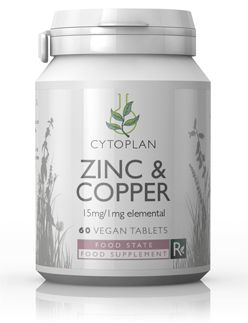
Food State Zinc is combined with copper to prevent a possible risk of copper deficiency during long-term usage. Zinc and copper compete for the same absorption sites, and an excess of zinc can ultimately cause a copper deficiency. Each tablet contains 15mg Zinc and 1mg copper. Food State Zinc is presented to the body complete with amino acids and nutrient carriers from the associated probiotic culture.
*Beneficially combined in a base of lactobacillus bulgaricus. This probiotic species is a native inhabitant of the human G.I. tract
Soil deficiencies have reduced zinc levels available in our food and some zinc is removed in food processing; deficiency is extremely widespread.
Symptoms of deficiency include; white spots on nails, stretch marks and a poor sense of taste. Zinc is needed for a healthy sex life and for prostrate health. Lack of zinc in pregnancy can lead to poor development of the foetus. All pregnant & nursing mothers would do well to take a 15 mg zinc tablet on retiring. Zinc performs over 300 enzymatic functions in the body and plays a role in virtually all biochemical pathways and physiological processes. Every cell in the body needs zinc; hundreds of body processes rely upon it. It has antioxidant properties, and is important to proper maintenance of Vitamin E levels in the blood. Also improves the activity of vitamin A. Moreover, it is a constituent of the powerful antioxidant superoxide dismutase. Your body cannot store zinc but has a rapid turnover rate which is why you need to keep supplies up. It is essential for a healthy immune system, helps to balance blood sugars through insulin, (also chromium & vanadium) helps to maintain healthy liver function, digestion and metabolism of carbohydrates It also helps to maintain a healthy nervous system
Ingredients
Zinc (food state) 15mg
Copper (food state) 1mg
Non-Active Ingredients: Vegetable stearic acid, vegetable magnesium stearate, microcrystalline cellulose and vegetable zein (tablet coating)
Free From: GMI, Wheat; yeast, starch, gluten, soy, added colourings, sweeteners and preservatives.
Directions
1 tablet daily or as directed by a practitioner
Suitable for: Vegetarians and for people with Candida and yeast sensitivities.
Contraindications: None.
Non GM & Free From: Wheat; yeast, starch, gluten, soy, added colourings, sweeteners and preservatives.
EXCIPIENTS: Whilst all RN own branded products are excipient free, some of our resale items are NOT. We endeavour to source products with the absolute MINIMUM excipients. All of these are non-allergic and inert and are only used in micro quantities.
Suitable for: Vegetarians and for people with Candida and yeast sensitivities.
Contraindications: None.
Non GM & Free From: Wheat; yeast, starch, gluten, soy, added colourings, sweeteners and preservatives.
EXCIPIENTS: Whilst all RN own branded products are excipient free, some of our resale items are NOT. We endeavour to source products with the absolute MINIMUM excipients. All of these are non-allergic and inert and are only used in micro quantities.
Zinc
Due to a lack of trace elements in the soil, even in most ‘organically’ farmed soils, trace element deficiency in modern society is almost universal. This is true even if you eat a healthy diet with plenty of organic fruit and vegetables, include raw vegetable juices in your diet or consume trace element rich superfoods such as Barley Grass Juice Powder and Seagreens
Soil deficiencies have reduced zinc levels available in our food supply and some zinc is removed in food processing. Zinc deficiency is extremely widespread. It’s symptoms of deficiency are numerous and often difficult to ascertain, however white spots on nails, stretch marks, poor sense of taste are strong indications of deficiency. Zinc is needed for a healthy sex life and for prostrate health. Lack of zinc in pregnancy can lead to poor development of the foetus, or in severe deficiency, to birth defects. All pregnant and nursing mothers would do well to take a 15 mg zinc tablet on retiring. Alcohol consumption depletes zinc levels in the body.
Zinc is considered an essential trace mineral. It performs over 300 enzymatic functions in the body and plays a role in virtually all biochemical pathways and physiological processes. Every cell in the body needs zinc; hundreds of body processes rely upon it. Zinc is needed for normal growth and development. Zinc also has antioxidant properties, and is important to proper maintenance of Vitamin E levels in the blood. It also improves the activity of vitamin A. Moreover, it is a constituent of the powerful antioxidant superoxide dismutase (SOD). Your body cannot store zinc but has a rapid turnover rate, which is why you need to keep supplies up.
It is essential for a healthy immune system, helps to balance blood sugars through insulin, (also chromium and vanadium) helps to maintain healthy liver function, digestion and proper metabolism of carbohydrates. It also helps to maintain a healthy nervous system, is involved in reproductive organs, prostate gland and healthy semen.
Zinc Requirements
Taking a zinc supplement of 15 mgs a day on an empty stomach is just about enough to eliminate a zinc deficiency status in the long term, there will be cases where more is needed on a long term basis, such as increased physical activity (e.g. those on athletic training), mal-absorption conditions, and regular sexual activity (especially males).
To overcome a zinc deficiency in a reasonable length of time – perhaps a few weeks extra zinc is required e.g. 30 mgs daily. A sensible protocol would be to take a multi-trace element supplement such as Colloidal Minerals any time of day on an empty stomach and isolated zinc (plus a little copper in the correct ratio) on retiring at a dose of 30 mgs for a few weeks. There after reductions in dose can be maintained and eventually, depending on the person, a multi trace element formulae that includes 7 mgs daily of food state zinc may be taken on retiring, or immediately on waking. The absorption of zinc is reduced by iron, and therefore if you take an iron supplement take it at the opposite end of the day to zinc, or at least a few hours apart. For some with higher zinc needs or mal-absorption, food state zinc with copper should be taken on its own on retiring (15 mg tablets) with a multi-trace supplement at another time in the day.
We supply Zinc in a food state form - see the article Food State Nutrients for more information.
You may also be interested in...
.jpg)